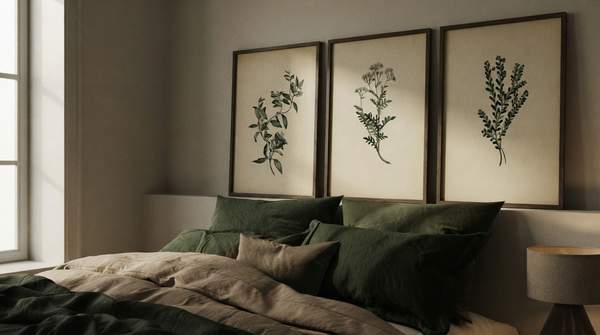
Yes, you can fill your home with found natural objects and still keep the calm, uncluttered look you want. The secret is not which materials you choose but how you apply a handful of minimalist principles to them: intentional selection, a restrained color palette, purposeful negative space, and a focus on natural form over ornament. Below, you will find a decision framework for evaluating any natural element, plus two step-by-step projects, a pressed botanical art display and a foraged branch centerpiece, that put those principles into practice.
Embracing Nature in Minimalist Decor: Core Principles
Minimalism and natural materials are natural partners. The Interior Design Institute describes minimalist interiors as built on a few structural rules, and each one maps neatly onto organic decor. The first is intentional material selection: choose a small palette of natural materials and repeat them throughout your home to create cohesion, rather than introducing a different texture in every corner.
The second is a restrained color palette. The Institute suggests moving past stark white toward warm cream, sand, stone, and soft terracotta, and COEL's design guidance makes the same point: neutral tones like white, grey, and beige create a cohesive backdrop, while warm timber finishes and natural materials keep a minimalist room from feeling cold or clinical.
The third principle is purposeful negative space, which the Institute defines as leaving empty areas on your walls and floors so a room has breathing room. Finally, layer organic materials so that natural grain, texture, and shadow create interest without adding clutter. Architectural Digest's style overview reinforces the same priorities, noting that minimalist spaces typically feature simple lines, neutral palettes, and deliberately limited decorative objects.
Decision Framework: Integrating Natural Elements Minimally
Use this framework as a reusable filter before any natural object comes through your door. Each row pairs a common material with the minimalist principle it serves best, an application tip, and the clutter risk that most often undermines it.
| Element Type | Key Minimalist Principle | Application Tip | Clutter Risk to Avoid |
|---|---|---|---|
| Wood / Branches | Focus on form and texture | Select pieces with a unique shape or strong natural grain; let the wood itself be the ornament. | Grouping many mediocre sticks instead of one striking branch. |
| Wood / Branches | Negative space | Display a single, sculptural branch in a simple vase with ample empty surface around it. | Filling the vase and surrounding tabletop with competing objects. |
| Stones / Pebbles | Restricted color palette | Choose smooth stones in muted, natural tones that echo your room's neutral backdrop. | Mixing bright or clashing colors that break the cohesive palette. |
| Stones / Pebbles | Intentional material selection | Arrange a small, uniform collection in one simple, shallow dish. | Scattering loose stones across multiple surfaces as filler. |
| Dried Botanicals / Leaves | Focus on form and texture | Frame pressed leaves or flowers in a floating or plain white frame so the natural shape is the focal point. | Busy frames or printed backings that compete with the specimen. |
| Dried Botanicals / Leaves | Negative space | Leave significant empty space around the pressed botanical inside the frame, letting the wall color show through. | Packing the frame edge-to-edge so nothing has room to breathe. |
The pattern across every row is the same: one material, one principle, one deliberate placement. If a candidate object cannot claim a row, it probably belongs outside rather than on your shelf.
DIY Project: Minimalist Pressed Botanical Art
Project One: Pressed Leaf or Flower Display
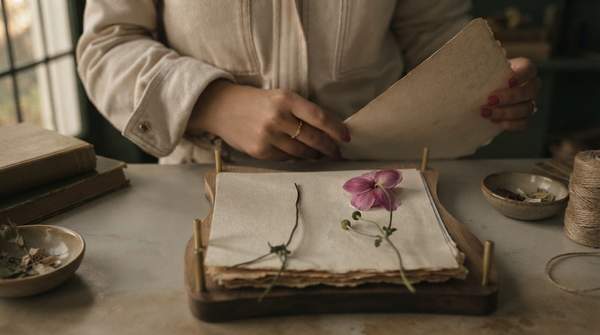
Lauren of the DIY blog Bless'er House describes pressing flowers in spring and summer to make art, and the project adapts perfectly to a minimalist brief. Gather a few leaves or blossoms with clean, recognizable shapes, then press them flat between the pages of a heavy book for a week or two until fully dried.
- Choose a simple frame: a floating glass frame or a plain white one with a neutral cream or sand backing.
- Select one to three specimens at most. A single leaf can carry an entire frame.
- Arrange them off-center with generous empty space around each one, letting the backing, and the wall color behind glass, act as negative space.
- Fix them in place, close the frame, and hang the piece alone on an otherwise empty stretch of wall.
Project Two: Foraged Branch Centerpiece
For a table version of the same idea, Bless'er House shares a foraged centerpiece method: snip a few stems from yard bushes, then give them a good soak in a sink filled with water and a splash of white vinegar to remove any bugs. Let the stems dry completely. To keep the result minimalist, place just two or three stems in one simple vessel, or lay them loosely around a pair of candlesticks, and leave the rest of the table bare.
Maintaining an Uncluttered Aesthetic
The projects are the easy part; the discipline comes afterward. Architectural Digest's characterization of the style is a useful checkpoint: minimalist rooms hold limited decorative objects, full stop. Once your pressed art is hung and your branch arrangement is placed, resist the urge to add more.
Repetition is your friend here. The Interior Design Institute's advice to choose a small palette of natural materials and repeat them means your stone dish, your branch vase, and your framed botanicals should feel like one family, not three unrelated souvenirs. Bless'er House's suggestion of filling a single bowl with acorns or pinecones works the same way, provided it stays one bowl on one table.
Finally, protect your negative space deliberately. Every new object you bring in should earn its place by adding form, texture, or a muted natural tone that the room does not already have. If it duplicates something already displayed, let it go. This article covers small decorative pieces only; furniture, flooring, and architectural choices are separate decisions, and the projects assume commonly found items gathered responsibly, not rare or protected species.
Creating Your Serene, Uncluttered Space
Apply these principles with confidence to any DIY natural decor project you take on, focusing on intentionality, simplicity, and negative space. The measure of success is a home environment that feels calm, organized, and connected to nature, with each decorative element serving a clear purpose without contributing to visual noise. Walk through your rooms and check each piece against the framework: if a branch, stone, or pressed leaf cannot name the principle it serves, that is your signal to edit it out.