If you want a scented home without trial and error, the fastest path is to match the project to your goal before you buy anything. Wax melts, reed diffusers, room sprays, and simmering potpourri all deliver fragrance, but they differ in how they release it, how long it lasts, and how much of your attention they demand. Here is how the four most beginner-friendly options compare, so you can pick your first project with confidence.
Understanding DIY Home Fragrance Projects
DIY home fragrance splits into two working styles. Passive methods, like reed diffusers, release scent continuously without heat or flames. Active methods, like wax melts in a warmer or a pot of simmering spices, need a heat source and deliver a stronger, more immediate scent while in use. CandleScience, a candle and soap making supply company, describes its beginner-friendly projects as flameless, quick to make, and releasing "a subtle yet steady scent into your space." Simmering potpourri sits on the other end: it is a heat-based method Monica Matheny outlines on The Yummy Life as fragrance added "using simmering waters infused with spices, herbs, & fruit." Knowing which style you want narrows your choice quickly.
Wax Melts: Flameless Ambiance
Wax melts are scented wax shapes you place in a warmer. As Maura explains in her wax melt recipe at Living Well Mom, "you will need to plug it in and wait a few minutes for the wax to start melting," after which the aroma begins diffusing. The key trade-off: there is no open flame, but the warmer itself is an electric appliance, so placement still matters. Her recipe uses almost 100 drops of essential oil, which she calls plenty for most people; if the scent is not strong enough, she suggests adding more drops of oil to the melted wax while it sits in the warmer. That adjustability makes wax melts forgiving for beginners who are still learning their preferred intensity.
Reed Diffusers: Continuous, Subtle Scent
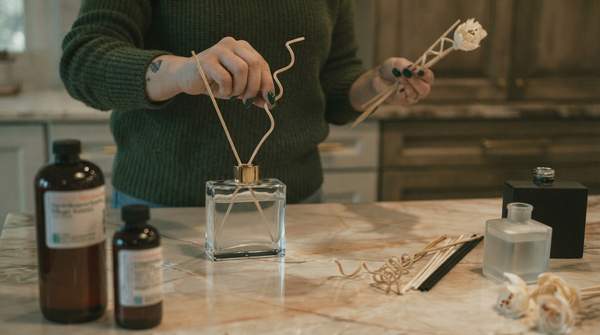
Reed diffusers are the set-it-and-forget-it option. Reeds absorb fragrance oil and slowly carry it up and out into the air, so the scent arrives steadily without any heat, flame, or daily attention. CandleScience calls them "the ultimate set-it-and-forget-it home fragrance option," which makes them ideal for entryways, guest rooms, or anywhere you want constant, low-level ambiance. Because the release is passive and gradual, they will never flood a room the way a simmering pot can. Plan for an initial setup—oils and reeds—and then minimal maintenance. The trade-off is patience: a diffuser rewards you over time rather than on demand.
Room Sprays: Instant Refresh
Room and linen sprays are the fastest route from unscented to scented. According to CandleScience, they "allow you to quickly fragrance your surroundings by spraying the air, blankets, sheets, fabric furniture, rugs, clothing, or other types of fabric" and "set the atmosphere of a room in an instant." They shine as a touch-up tool: spritz bathmats, towels, couches, or curtains before guests arrive, and keep a bottle on hand for quick refreshes in bathrooms or on linens. The limitation is duration—a spray delivers a burst of scent that fades, so it suits on-demand boosts rather than all-day ambiance. It is also the lowest-effort project to make, with no heat source required at any point.
Simmering Potpourri: Quick Burst of Aroma
Simmering potpourri is the most active—and often the most aromatic—of the four. As Pam Kessler describes it at House of Hawthornes, it is a stove-top method: "a quick and easy potpourri recipe to make your home smell fresh and cozy" using just a few ingredients, water simmered with spices, fruit, and herbs. Because the heat releases the volatile oils directly, it fills a space fast and can be tuned by adding whatever you have on hand. The costs are real, though: it ties up a stove burner, needs occasional water top-ups, and requires monitoring so the pot never boils dry. It is a session-based scent, not a background one—perfect for an afternoon of baking or an evening with guests, not for a permanently fragrant house.
Choosing Your Perfect Project: Key Trade-offs
The deciding questions are intensity, duration, and how much attention you want to give.
- Choose a flameless, passive option when safety and convenience come first. Reed diffusers and room sprays involve no heat at all. Reed diffusers work continuously with minimal effort; sprays work instantly but briefly.
- Choose an active, heat-based scent when you want power. Wax melts and simmering potpourri both use heat to push scent outward. Wax melts need only a plug-in warmer and a few minutes; potpourri needs a stovetop and monitoring but delivers the broadest, fastest fill of a space.
- Match the method to the room and moment. A diffuser suits small, contained rooms and constant ambiance; a spray suits linens and fabric-heavy spaces needing a quick lift; a warmer suits evening relaxation; a simmering pot suits kitchen gatherings and cozy weekends.
DIY Home Fragrance Project Comparison
| Project | Scent Release | Best For | Relative Effort | Scent Longevity |
|---|---|---|---|---|
| Wax Melts | Active — electric warmer melts the wax, no open flame | Flame-free ambiance; relaxing evenings at home | Low to medium — melt, pour, then plug in a warmer | A few hours per session; adjustable with more oil drops |
| Reed Diffusers | Passive — reeds absorb and slowly diffuse fragrance oil | Constant, subtle background scent; set-and-forget spaces | Low — one-time assembly, then minimal management | Longest of the four; steady release for an extended period |
| Room Sprays | Active — direct application to air and fabrics, no heat | Instant refreshes; linens, rugs, and pre-guest touch-ups | Lowest — mix and spray | Short — a temporary burst best repeated as needed |
| Simmering Potpourri | Active — stovetop heat releases oils from spices, herbs, fruit | Quickly filling a whole space; cozy gatherings and holidays | Medium — needs a burner, water top-ups, and monitoring | Only while simmering; scent fades when heat stops |
Read across the rows and the pattern is clear. If your priority is duration with the least ongoing attention, the reed diffuser wins. If it is immediacy, the spray wins. If it is intensity without an open flame, wax melts win. If it is maximum scent across a whole floor for a specific occasion, the simmering pot wins.
Making Your Scented Choice
Choose a DIY home fragrance project by matching your desired scent intensity, duration, and required effort with the characteristics of wax melts, reed diffusers, room sprays, or simmering potpourri. The reader successfully selects a project type that aligns with their personal preferences and practical constraints—and that selection is easy to verify. Ask three questions: Do I want constant background scent or an on-demand burst? Am I comfortable with a heat source? How long should a single session of effort pay off?
A "yes" to constant background points to a reed diffuser; a "yes" to heat and intensity points to wax melts or a simmering pot; a preference for zero heat and zero commitment points to a room spray. Start with one, watch how long its scent actually lasts in your own space, and you will have a measured baseline for deciding whether your next project should move along the intensity spectrum.
Sources
- DIY Natural Room Scents — The Yummy Life
- How to Make Homemade Wax Melts with Essential Oils — Living Well Mom
- Crafting Cozy Vibes: DIY Home Fragrance Projects — CandleScience - Candle and Soap Making Supplies