You don't need a shelf of pre-made recipes to fill your home with a scent that matches your mood. What you need is a simple framework: pick the mood you want, choose a middle note to carry it, add a lighter top note, and anchor everything with a base note. Perfumers have used this three-note structure for generations, and it works just as well in a living-room diffuser as it does in a bottle of fine fragrance.
This guide walks you through the blending principles, a step-by-step decision framework, the three most practical delivery methods for your finished blend, and a few starter recipes that show the principles in action. It covers aromatic use only — no candles, no topical or internal use — and general safety reminders at the end.
Understanding Essential Oil Blending: Notes and Categories
Fragrances are built in layers, and blenders describe those layers as notes, much like music. The top note is what you smell first — bright, light, and quick to fade. The middle note makes up the bulk of the fragrance, becoming apparent underneath the top note. The base note is the heaviest scent and the slowest to disperse; it's the one you're left with the longest, as Natio's blending guide by Allison Harvey explains.
Common oils sort neatly into these roles. Eucalyptus, lemon, lemongrass, lemon myrtle, sweet orange, and peppermint work as top notes. Geranium and lavender sit in the middle. Cedarwood anchors a blend as a base note. A balanced blend usually draws from all three layers so the scent evolves rather than hitting you all at once and disappearing.
Alongside notes, scent families matter. A doTerra blending guide offers a few key rules: woodsy and floral scents combine well with almost every other essential oil category, while spicy, herbaceous, and minty oils can quickly overpower other aromas and should be used moderately — ideally blended in small amounts with citrus or floral scents. The goal is complementarity, so that no single oil drowns out the others.
Your Custom Scent Blending Decision Framework
Here is a repeatable method for designing a balanced blend around a mood, rather than copying someone else's recipe. Work through the four steps in order, and keep your total small while you experiment — Natio suggests starting with 10 drops of essential oils in total, mixed in a clean bowl or bottle, ideally a small amber glass bottle that protects the oils from sunlight and slows evaporation.
| Step | Question | How to decide |
|---|---|---|
| 1. Define the mood | What atmosphere do I want? | Name it concretely: relaxation, energy, freshness, coziness. This drives every later choice. |
| 2. Choose a middle note | What is the heart of the scent? | The middle note forms the bulk of the fragrance. Lavender suits calm; geranium suits a softer floral heart. |
| 3. Add a top note | What do I smell first? | Pick a light oil that complements the heart — citrus like lemon or orange for brightness, peppermint for alertness. |
| 4. Anchor with a base note | What lingers? | A heavy, slow oil like cedarwood or sandalwood rounds the blend out and makes it last. |
Apply the category rules as you fill in the matrix. Because woodsy and floral scents pair with almost everything, they're the safest building blocks for a first blend. If you want spice, herbs, or mint, add them sparingly — a drop or two — and lean on citrus or florals to keep them in check. If one oil starts to dominate, reduce it rather than adding more of everything else.
Start with two or three oils and adjust until you find your favorite combination, as Aromely's guide recommends. Ten drops total is enough to judge a blend, and a small amber bottle lets you revise without waste.
Choosing Your Delivery Method: Diffusers, Sprays, and Sachets
Once your blend exists, the delivery method determines how it fills the space. Each of the three most common methods needs a different base.
- Ultrasonic diffusers. These use water and essential oils to fragrance a room. Fill the diffuser with clean water according to the manufacturer's instructions, then add your oils. Aromely suggests 5–15 drops is sufficient for most home diffusers, depending on room size, diffuser capacity, and personal preference — and always follow the manufacturer's recommendations.
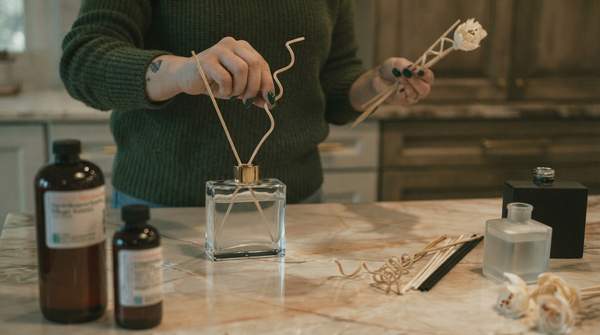
- DIY reed diffusers. These need a carrier oil base to dilute the essential oils and carry them up the reeds. Sijo's DIY guide recommends safflower or grapeseed oil, added to a mixing jar, then transferred to a decorative jar with a narrow, vase-like opening. Natio also lists jojoba and sweet almond as common carrier oils. Expect a DIY reed diffuser to last roughly 6–12 weeks, depending on the carrier oil, room temperature, humidity, and how often you flip the reeds.
- DIY room sprays. Water and essential oils alone will separate, so sprays need an emulsifier — witch hazel or alcohol helps the oils blend with the water, as Lively Living's guide explains. Sijo's version uses about 25–30 drops of your chosen blend. Shake well before each use, and replace the batch when the scent turns or dissipates.
Match the method to the moment: a diffuser for continuous background scent, a reed diffuser for a flame-free, steam-free steady fragrance, and a spray for an instant burst when you want it.
Starter Blends: Putting Principles into Practice
These starter recipes from Aromely show the framework at work. Notice how each one follows the note structure — and how the oil choices match the stated mood.
- Relaxation Blend (suggested for bedtime): 4 drops lavender, 3 drops chamomile, 2 drops sandalwood. Lavender carries the blend as the middle note, chamomile deepens the calming heart, and sandalwood anchors it with a slow, lasting base.
- Energy Blend (designed to provide an energy boost): 3 drops peppermint, 3 drops lemon, 2 drops rosemary. Peppermint and lemon are both bright top notes for alertness, while rosemary adds an herbaceous edge — used in moderation here so it doesn't overpower the citrus.
- Fresh Home Blend (ideal for kitchens and living rooms): 3 drops lemongrass, 2 drops sweet orange, 2 drops eucalyptus. All light, clean top notes, weighted toward lemongrass so the freshness lasts a little longer.
- Cozy Autumn Blend (for a warm, inviting atmosphere): 3 drops cedarwood, 2 drops cinnamon, 2 drops vanilla. Cedarwood is the heavy base note, and the spicy cinnamon is kept to two drops — exactly the moderation the blending rules call for.
Once you see the pattern, you can swap oils within the same note and category. Prefer a different floral heart than chamomile? Keep the structure, change the oil, and test ten drops at a time.
Achieving Your Desired Home Atmosphere
Readers can confidently create custom home scents by applying blending principles and choosing appropriate delivery methods. The practical decision is simple: name your mood, build a three-note blend around it using the matrix above, and pick the delivery method that fits how you want the scent to behave — continuous, steady, or on demand.
The measurable indicator of success is a home environment that consistently evokes the intended mood (e.g., calm, energetic) through personalized essential oil blends. If your first blend doesn't land, adjust one variable at a time — swap the top note, soften the base, or rebalance the drops — and retest.
One standing caution: safety information here is general. Always check specific contraindications for the oils you use, especially regarding pets, children, or medical conditions, before diffusing them in a shared space.
Sources
- How to create your own essential oil blend — Natio
- MEDIA
- How To Make Your Own Natural Fragrances? — AROMELY
- DIY Essential Oil Projects — Sijo
- DIY Essential Oil Recipes for Home and Body — Lively Living