You can replace most of your commercial cleaning products with a small kit built from vinegar, baking soda, and a few reusable tools. The core idea is simple: household messes fall into two broad chemical camps, and each camp responds to a different type of cleaner. Greasy, organic messes break down best with alkaline cleaners like baking soda, while mineral-based, inorganic buildup dissolves with acidic cleaners like vinegar.
That single distinction, drawn from guidance published by the University of Arkansas System Division of Agriculture's extension service, is what lets you stop guessing at the cleaning aisle and start mixing your own effective, non-toxic solutions at home.
Understanding Your Mess: Acidic vs. Alkaline Cleaners
Before you mix anything, it helps to know why these ingredients work. Baking soda, according to the extension service, is a mild alkali scouring powder that can be used for almost all household cleaning purposes. It also absorbs odors, removes baked-on food from pans and ovens, and lifts stains from fruit juices and other mild acids, as well as from glass, tile, and china. That versatility comes from its alkaline nature: alkaline substances help break down fats and oils, which is why they excel on organic messes like dirt, grease, and food stains.
Inorganic messes work the other way around. Hard water deposits, rust, tarnish, and soap scum are mineral-based or alkaline themselves, and acids dissolve mineral deposits while neutralizing alkaline residues. Vinegar and lemon juice are the common acidic ingredients for this job. The extension service credits Pamela Turner of the University of Georgia Cooperative Extension for many of the recipes underlying this approach.
One caveat worth keeping in mind: this is a general guideline, and specific messes may vary in their composition and required approach. The effectiveness of an acidic cleaner also depends on the concentration of the acid and how long you leave it on the buildup—stubborn mineral deposits need dwell time, not just a quick wipe.
Matching Cleaners to Messes: An Explanatory Guide
Use this table as your decision framework. Identify whether the mess is organic or inorganic, then reach for the matching cleaner type and key ingredient.
| Type of Mess | Chemical Nature | Effective Cleaner Type | Key Ingredients | Example Messes |
|---|---|---|---|---|
| Organic | Often acidic or fatty | Alkaline (base) | Baking soda, washing soda | Dirt, grease, food stains, baked-on food |
| Inorganic | Mineral-based or alkaline | Acidic | Vinegar, lemon juice | Hard water deposits, rust, tarnish, soap scum |
The reasoning path is straightforward: organic grime like grease and food residue is fatty, and alkaline cleaners break down fats and oils. Inorganic grime like limescale and soap scum is mineral buildup, and acids dissolve those deposits. Match the chemistry, and the mess comes off with less scrubbing.
Your Starter Recipes
With the framework in place, you only need a couple of recipes to cover most everyday cleaning. Both rely on ingredients available in any grocery store's baking section.
Alkaline scouring powder. According to the zero-waste recipe site Zero Waste, many things can be cleaned by simply scrubbing with baking soda, and for tougher stains you can mix baking soda with washing soda, a powerful natural cleaner often used in laundry powder. To make it:
- Combine baking soda with washing soda for tough stains; use plain baking soda alone for everyday jobs.
- Sprinkle the powder on the surface—baked-on pans, oven spills, stovetops, or the refrigerator.
- Scrub with a damp reusable cloth or natural-bristle brush until the mess lifts.
- Rinse or wipe clean with water.
Washing soda may not be stocked everywhere, but the same source notes it is easy to make at home. The chemistry is a small but satisfying upgrade: baking soda has the chemical composition NaHCO3, while washing soda is Na2CO3—a stronger alkaline agent for heavier grime.
Acidic mineral-buster. For the inorganic side of the table, keep vinegar on hand. Apply it to hard water deposits, soap scum, and tarnish, give the acid time to dwell on the buildup, then scrub and rinse. Lemon juice works the same way as a natural acid for smaller jobs. Because acidic cleaners' effectiveness depends on concentration and dwell time, patience matters more than elbow grease here.
Everyday odor and gentle cleaning. Baking soda alone covers a surprising range: the extension service recommends it for cleaning refrigerators, absorbing odors when left in an open box inside the fridge, and even sprinkled on carpet before vacuuming. It also removes stains from fruit juices and other mild acids on glass, tile, and china.
Safety and Storage: The Non-Negotiables
Homemade does not mean risk-free, and the extension service's safety guidance is blunt on the critical points:
- Never mix bleach with ammonia—the combination produces toxic gases.
- Never mix bleach with anything but water. That includes vinegar and other homemade ingredients.
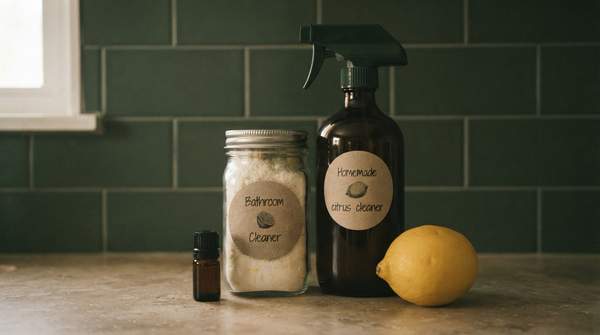
- Label every homemade solution with its contents and the date you mixed it, so no one in the household has to guess what's in the bottle.
- Mix in a well-ventilated area to avoid inhaling concentrated fumes.
For storage, reusable glass spray bottles and jars are the natural zero-waste choice, and they pair well with washable cloths and natural-bristle brushes instead of disposable wipes and plastic sponges. One sustainability note from the broader zero-waste guidance: use up the plastic tools and products you already own before replacing them—the most zero-waste item is the one you don't buy.
What This Kit Can't Do
This kit is for general cleaning, not disinfection. Homemade cleaners are not recommended for killing viruses like SARS-CoV-2, so situations that call for true disinfection—raw meat spills on counters, illness in the household, bathroom surfaces during a stomach bug—warrant an appropriate disinfectant rather than a DIY solution. The kit also sticks deliberately to common ingredients; it doesn't cover specialty or hard-to-find items, and it doesn't attempt to evaluate commercial "green" cleaning products.
Start Your Zero-Waste Cleaning Journey
Readers should assemble a basic zero-waste cleaning kit using the provided DIY recipes and apply the understanding of acidic vs. alkaline cleaners to tackle various household messes effectively and safely. Start with the smallest possible kit: one box of baking soda, a jug of vinegar, optional washing soda for tough stains, a couple of glass bottles, and reusable cloths.
Then put the framework to work. Greasy stovetop? Alkaline scouring powder. Soap-scummed shower door? Vinegar, with dwell time. The measurable indicator of success is threefold: successful removal of common household grime using DIY solutions, reduced reliance on commercial cleaning products, and proper, safe storage of homemade cleaners. When those three conditions describe your cleaning cupboard, your kit is doing its job.
Sources
- Clean and Green Homemade Cleaners — Clean and Green Homemade Cleaners | How to make environmentally friendly cleaners
- The Kitchen Chemist – DIY Zero-Waste Cleaning Recipes — Zero Waste