Here's the honest answer up front: there is no single fragrance or diffuser that's cleared as safe for every pet. Risk depends on the species, the ingredient and its concentration, the device, the route of exposure, the room, and your pet's health history. That's the core message from pet-wellness guidance on pet-safe fragrance, and it's actually good news. It means you don't need a memorized list of "safe" and "unsafe" products. You need a repeatable way to judge any product against your specific pet and your specific home. That's exactly what this guide gives you.
Introduction: Beyond Simple "Safe" or "Unsafe"
I used to think pet-safe fragrance meant finding the right list. Find the list, buy the approved candle, done. But that approach falls apart fast. A scent that's fine for your dog might be hazardous for your cat, and vice versa — a point fragrance retailers themselves make when advising pet owners. The same product can be low-risk in one home and a real problem in another.
So instead of asking "is this product pet-safe?", the better question is "is this product safe for my pet, in my space, used this way?" Three factors do the work: the product itself, your pet's vulnerabilities, and your environment. Get those three straight, and you can evaluate anything on the shelf — today's reed diffuser or next year's new plug-in.
One more thing before we dive in. This framework covers common household pets, mainly cats and dogs. Birds and small mammals are mentioned where sources flag their sensitivity, but they're not covered in depth. And nothing here replaces your veterinarian — especially if your pet has existing health issues.
Understanding Fragrance Product Risks
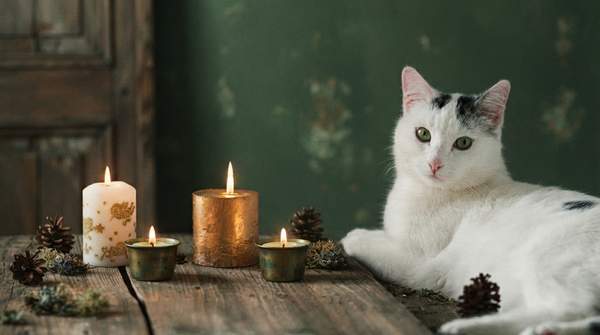
Why do fragrances bother pets at all? Two reasons. First, the route of exposure. Pets don't just smell these products — they inhale the airborne particles, and concentrated oils can land on their fur. Then comes the part we forget: grooming. Cats especially lick residue off their coats, turning a skin-level exposure into ingestion.
Second, the delivery method matters as much as the ingredient. A diffuser, spray, or plug-in actively puts scent into the air your pet breathes. A passive product sitting on a high shelf releases less — but becomes a poisoning risk if knocked over or licked. The same guidance is blunt about the lowest-exposure option: remove the odor source entirely and keep the home fragrance-free. That's the baseline every other choice is measured against.
And "natural" isn't a safety guarantee. Essential oils are plant-derived, but they're still concentrated chemicals that pets can inhale, lick, or absorb through skin. Natural framing tells you nothing about dose, concentration, or how your particular pet metabolizes it.
Assessing Your Pet's Vulnerability
Not all pets face the same risk from the same product. Species comes first. Cats need especially cautious handling, and dogs can also become ill after inhaling, licking, or getting concentrated oils on their skin. Cats have a double disadvantage: smaller organs processing the same room air a 150-pound human breathes, plus a unique liver metabolism that struggles with certain compounds — which is why feline essential-oil toxicity can show up quickly and seriously.
Then look at the individual. Fragrance guidance for diffuser users flags young pets (dogs or cats under ten weeks), smaller dog breeds, and short-nosed dogs as particularly sensitive — the short-nosed breeds because they're already predisposed to respiratory issues. Pregnant animals, older animals, and pets who are ill or recovering also carry higher risk.
Finally, health history. If your pet has asthma, allergies, or heart or lung disease, the advice is consistent: ask your veterinarian before introducing any fragrance product. A scent that a healthy adult dog shrugs off can be a genuine problem for a senior cat with compromised lungs.
Implementing Safe Usage and Environmental Controls
You can't change your pet's liver. You can absolutely change the environment. Ventilation is your biggest lever — airing the room dilutes airborne irritants and lowers the concentration your pet actually breathes. That matters most in colder months, when sealed-up homes let chemicals accumulate instead of dispersing.
Placement and access come next. Keep fragrance products — especially oils and diffusers — physically out of reach. Accidental ingestion of a concentrated product is the severe-exposure scenario, and it's entirely preventable with a high shelf and a closed door.
Then, usage discipline. Keep pets out of the room while a device is operating, and air the room before they return. Start subtle: small amounts, gentle wafts rather than fragrance floods. And watch. Animals can show stress or anxiety when confronted with scents they perceive as threatening, so pay close attention to your pet's reaction with every new product. If they avoid the room, that's information.
Your Pet-Safe Fragrance Decision Framework
Here's the reusable method. Run any product through these three dimensions, and the required precautions — or the verdict that it's too risky — fall out of the combination.
| Dimension | What to check | What the evidence says | How it changes your decision |
|---|---|---|---|
| Product & exposure risk | Delivery method, ingredients, concentration | Diffusers, sprays, and plug-ins enable inhalation and skin contact; residues on fur can be ingested during grooming | Active dispersal methods raise exposure; passive or fragrance-free options lower it |
| Pet vulnerability | Species, age, size, health history | Cats and birds need especially cautious handling; young, old, pregnant, ill, small, and short-nosed pets are higher-risk | Any vulnerability factor means more caution — or a veterinarian consult before use |
| Environmental controls | Ventilation, placement, access, monitoring | Ventilate after use, keep products inaccessible, keep pets out during operation, start small and watch for reactions | Good controls can make a moderate product manageable; poor controls make even mild products risky |
How to read the result: if your product scores high on exposure risk and your pet has vulnerability factors, you need every environmental control in place — or you skip the product. If both are low, modest use with monitoring is reasonable. The framework doesn't hand you a universal green light. It tells you which precautions your specific combination demands, or when to conclude a product is simply too risky for your situation.
Recognizing Signs of Distress in Pets
Know the warning signs before you plug anything in. Watch for avoidance, sneezing, watery eyes, drooling, coughing, vomiting, or a change in breathing. Feline essential-oil toxicity in particular can show up quickly, with drooling and difficulty breathing among the recognized signs. A pet leaving the room every time the diffuser runs is telling you something too.
The rule is simple: stop immediately if any sign appears. Don't wait to see if it passes.
Emergency Action Protocol: What to Do If Symptoms Appear
If your pet exhibits any signs of distress or poisoning from home fragrances, immediately remove them from the scented area, ensure ventilation, and contact your veterinarian or a pet poison control center. Before you call, grab the original package or a clear photo of the ingredient label — a veterinarian or poison service will need the exact product, your pet's species, the amount involved, and the route of exposure.
Then watch the outcome. The measurable indicator that things are resolving: your pet's symptoms — drooling, vomiting, lethargy, difficulty breathing — subside, or a veterinarian provides clear instructions for next steps. Until one of those happens, keep them away from the product and follow professional guidance. And if your pet has pre-existing conditions, make the call before the next new scent ever enters your home.
Sources
- Pet-Safe Fragrance: A Safer Home Scent Guide — Viva Essence Pet
- Natural, pet-friendly scents and reed diffuser — Pawness
- Essential Oils That Are Safe for Cats: The Definitive Guide — Aroma360
- Pet-Safe Scenting: A Guide for Fragrance Reed Diffuser Users — Hotel Collection