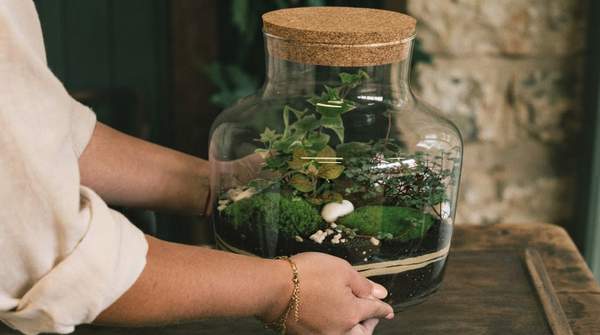
Yes, a sealed jar of plants really can take care of itself. Build a closed terrarium with a drainage reservoir, a charcoal filter, and the right humidity-loving plants, and the container becomes its own tiny water cycle: moisture condenses on the glass, drips back into the soil, and is drawn up again by the roots. The Mississippi State University Extension Service, whose closed-system design guide anchors this article, treats the terrarium as exactly that — a self-contained ecosystem rather than a fussy houseplant arrangement. Here is how to choose plants that belong together, assemble the layers in the right order, and intervene as little as possible once the lid goes on.
Understanding the Closed Terrarium Ecosystem
The defining feature of a closed terrarium is the seal itself. By trapping humidity inside, the glass becomes a consistent microclimate, which is why tropical plants — and many temperate woodland species — can thrive in one, according to Dan Jones, who writes the Terrarium Tribe guides and describes the system as one that "reuses the same water over and over." A well-built closed terrarium can go months, sometimes longer, without watering, because almost nothing escapes. The light shining through the glass drives photosynthesis; transpiration lifts water from the leaves; condensation returns it to the soil.
That sealed loop is also the system's vulnerability. In a closed container, fallen leaves, dead roots, and other organic matter eventually break down, a process that releases gases and by-products capable of disrupting the balance, as the Miyagi Bonsai terrarium guide explains. The whole build, in other words, is an exercise in giving the ecosystem ways to manage its own water and waste. Every layer below serves that purpose: the drainage layer buffers excess moisture, the charcoal filters what passes through, and the substrate holds roots in a damp — never waterlogged — medium. Get these right at assembly, and your later care shrinks to watching the glass and occasionally opening the lid.