Yes, you can build a soothing indoor tabletop fountain yourself with just three things: a watertight container, a small submersible pump rated under 100 gallons per hour, and a handful of stones and plants to dress it up. The quietest, most satisfying fountains come from matching those parts deliberately — a pump strong enough to lift water to the top of your design, yet gentle enough that it whispers rather than splashes. The evidence-backed guidance below, drawn chiefly from Kent Kobayashi's instructional page hosted by the University of Hawaii's College of Tropical Agriculture and Human Resources and from gardener Marianne Willburn's container-water-feature experience, walks through how to choose the components, put them together, and keep the water clear. It covers small, submersible-pump tabletop fountains only — not wall-mounted features or outdoor ponds.
Decision Framework: Choosing Your Tabletop Fountain Components
Before buying anything, settle three preferences: how much space you have, the sound you want to hear, and how much upkeep you will tolerate. Those three answers drive every component decision, because each part constrains the others. A tall fountain demands a stronger pump; a small bowl rules one out. Living plants add a rooting routine that artificial greenery avoids. Work through the matrix below and you will come away with a personalized parts list whose pieces actually work together.
| Component | What to consider before buying | How it shapes the fountain's sound, look, and upkeep |
|---|---|---|
| Container | Must be watertight — no leaks — and large enough to fully submerge the pump. Options range widely: Willburn describes having used 12-inch flat-bottomed bowls as simple patio-table centerpieces as well as a three-foot ceramic basin fed by an oversized wine bottle. | Anchors the look and the stability. A larger container can accommodate more decorative elements and a stronger pump; a small bowl suits the smallest pumps and the gentlest presentation. |
| Pump | Choose a small submersible pump — available at pet shops, hardware stores, and garden supply centers — with an output of less than 100 gallons per hour for typical tabletop containers. Look for suction cup feet, a quiet motor, simple maintenance, and, importantly, a water flow adjustment. Ask whether a pump has flow control before purchasing. | Determines whether water reaches the top at all: the taller the fountain, the more gallons per hour you need. A pump that is too weak will not achieve the desired water movement; one that is too strong creates excessive splashing. Flow control lets you tune between a gentle trickle and a livelier splash. |
| Decorative elements | Stones, pebbles, and plants — real or artificial ivy, bamboo, flowers, moss, or foliage. Choose materials suited to continuous water exposure. | They conceal the pump and cord, and the arrangement of the stones directs the water's path, so their placement helps compose the trickling sound itself. You can also leave the design plain. |
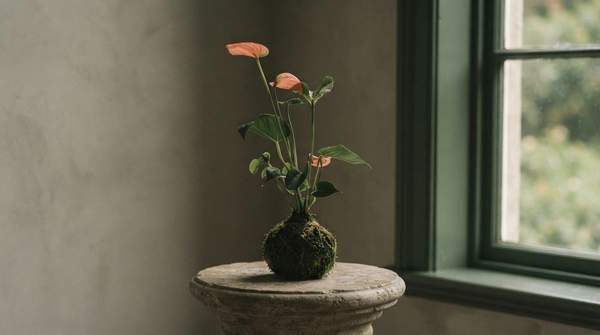
On plants specifically, Kobayashi offers a flexible technique: pot a plant with soil in a small flower pot or glass container — one without a hole in the bottom — and place it anywhere in the fountain. When the roots get too big, simply replace it with another plant. Alternatively, fill a small pot or glass with water, set the plant in that, and nest the whole pot into the fountain. If you would rather skip living-plant care entirely, artificial ivy and bamboo achieve a similar look with none of the horticulture. Note that detailed aquatic-plant growing advice sits outside this guide's scope; the focus here is assembly and care of the fountain itself.
One caution as you finalize the parts list: resist buying the pump first and the container later, or the strongest pump on the shelf. Because the evidence stops short of a GPH-to-sound chart, the reliable principle is simply that pump power must match both the vertical lift you want and the movement you hope to see. For most tabletop designs, the smallest pumps — under 100 GPH — work well, with flow adjustment covering the fine tuning.