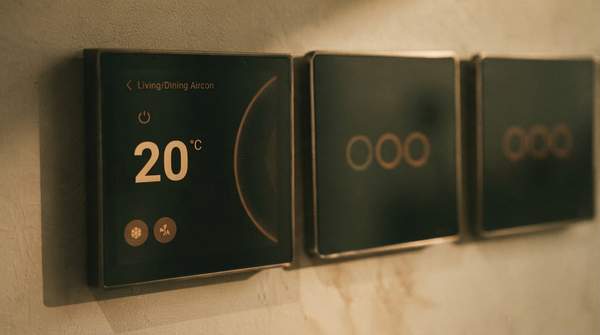
The best smart climate control upgrade for your home comes down to two things: what your existing HVAC equipment can handle, and what you actually want it to do. If you want whole-home efficiency and remote control, a smart thermostat is usually the answer—provided your wiring includes a C-wire. If you want room-by-room temperature control, smart vents can deliver zoning, but they carry a real risk of blower motor damage on single-speed systems. Here's how to figure out which path fits your home.
Understanding Smart Climate Control Options
Smart climate control for an existing home generally means one of two retrofit approaches. A smart thermostat replaces your existing wall unit and adds app control, scheduling, learning, and features like geofencing. Smart vents replace your existing floor or wall registers and open or close individually to direct conditioned air where it's needed.
The distinction matters because the two approaches solve different problems. A smart thermostat optimizes how your whole system runs. Smart vents change where the air goes. And the right choice depends heavily on what kind of equipment is behind your walls.
That's because modern HVAC systems vary widely in capability. As Daikin explains, traditional systems simply run flat-out until the target temperature is reached, while newer inverter-driven systems vary compressor speed to deliver exactly the heating or cooling required—cruising steadily rather than repeatedly accelerating and braking. That difference in airflow flexibility is exactly what determines whether smart vents are safe in your home.
Smart Thermostats: Core Requirements and Benefits
A smart thermostat is the most straightforward upgrade, but it has one critical prerequisite: wiring. Consumer Reports advises that if you have a ducted HVAC system, you should open up your existing thermostat to see what kind of wiring you have. Most nonconnected programmable thermostats work with as few as two low-voltage wires, common in older heating systems, but newer smart thermostats often require a common wire—a C-wire.
The C-wire provides the continuous power that Wi-Fi thermostats need. Sensi, a thermostat maker, notes that the wire's color isn't standardized, though blue or black are most common, and that traditional thermostat wiring uses four or more wires. If your home lacks one, Honeywell Home lays out your options: check for an unused C-wire hidden in the wall, use a C-wire adapter, or contact an HVAC professional.
Assuming the wiring checks out, the benefits are broad. Smart thermostats work with most modern forced-air systems, heat pumps, and zoned systems, and homes with regular occupancy patterns benefit most, since learning algorithms optimize around your routine. They struggle more in houses where schedules constantly change or multiple people have conflicting temperature preferences. Note that multiple heating or cooling systems or zones may require separate thermostats.
Smart Vents: Zoning Potential and Critical Risks
Smart vents promise something a single thermostat can't: individual room temperature control within an existing central system. That's genuinely appealing if one room is always freezing while another swelters.
But there's a serious catch. Closing too many vents creates excessive static pressure that damages your HVAC blower motor and reduces system efficiency, and these systems work poorly with single-speed equipment that lacks variable airflow capability. In other words, the older and simpler your equipment, the more dangerous smart vents become.
Variable-speed and multi-stage systems are better suited for smart vent integration because they can adjust output rather than pushing full airflow against closed registers. Daikin's comparison of single-speed and inverter systems illustrates why: a conventional system only knows full speed, so restricting its airflow forces it to strain against the blockage.
Cost and maintenance add further considerations. Individual smart vents run $80 to $150 each, and whole-home coverage typically requires 6 to 12 units. Battery-powered models need battery replacement every 1 to 2 years, while hardwired options require professional installation.
Your Smart Climate Control Compatibility Checklist
Before you buy anything, run through these checks. They take minutes and can save you an incompatible purchase—or a damaged blower motor.
- Open your existing thermostat and check the wiring. Count the wires and look for a C-wire, most commonly blue or black. If it's missing, plan for an adapter, a hidden unused wire, or professional help before buying a Wi-Fi thermostat.
- Identify your HVAC system type. Determine whether your blower and compressor are single-speed or variable-speed/multi-stage. This single fact decides whether smart vents are a viable option or a risk to your equipment.
- Match the thermostat model to your system. Compatibility varies by model and HVAC system type—most modern forced-air systems, heat pumps, and zoned systems work with smart thermostats, but specific model features must be verified before purchase.
- Consider your household's schedule. Learning thermostats deliver the most value with regular occupancy patterns; erratic schedules or conflicting preferences blunt their advantage.
- Count your vents and budget accordingly. If zoning is your goal, estimate 6 to 12 smart vents at $80 to $150 each, plus batteries or professional wiring.
Smart Climate Control Decision Framework
Use this matrix to map your HVAC setup and goals to the right solution. The key technical prerequisite for each option determines which scenarios it fits safely.
| Solution Type | Key Compatibility Requirement | Best For (Primary Goal) | Potential Risks/Limitations |
|---|---|---|---|
| Smart Thermostat — replaces existing thermostat for remote control, scheduling, and learning | Continuous power via a C-wire for many Wi-Fi models; connection to a central HVAC system with compatible wiring | Whole-home energy efficiency, remote control, and automated adjustments—especially with regular occupancy routines | Not all models support all HVAC system types; multiple systems or zones may need separate thermostats; verify model compatibility before purchase |
| Smart Vents — replace existing vents for room-by-room zoning | Variable-speed or multi-stage HVAC equipment that can adjust airflow; typically 6–12 units for whole-home coverage | Granular, individual room temperature control and zoning within an existing central system | Closing too many vents on single-speed systems creates excessive static pressure that damages the blower motor and reduces efficiency; batteries need replacement every 1–2 years; hardwired versions need professional installation |
The framework points to a clear split. If your wiring has a C-wire and your goal is efficiency and convenience, a smart thermostat is the low-risk, high-value move. If your goal is room-level zoning, first confirm your system is variable-speed or multi-stage—on single-speed equipment, smart vents pose a genuine threat to your blower motor.
Choosing Your Smart Climate Control Upgrade
Select a smart climate control system that aligns with your existing HVAC system's capabilities and your primary comfort and efficiency goals, prioritizing compatibility checks to prevent system damage. In practice: check your thermostat wiring for a C-wire before ordering any Wi-Fi model, and confirm your blower is variable-speed or multi-stage before committing to smart vents. The measurable indicator of success is straightforward—successful installation and stable operation of the chosen smart climate control device without error messages or HVAC system malfunctions. If your thermostat boots up cleanly and holds a stable connection, or your vents cycle without the system straining, you've made the right call for your home.