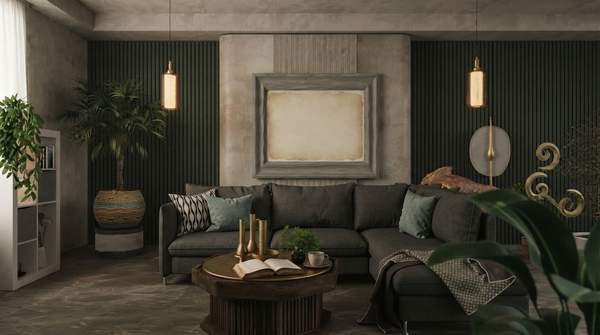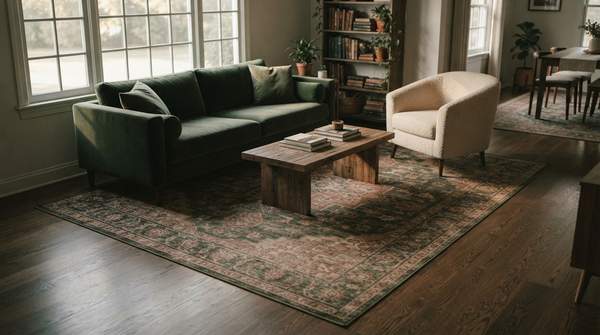
Most rugs fail not because of their color or pattern, but because they are too small for the room and wrongly placed under the furniture. The fix is mechanical, not aesthetic: a short set of measurement rules tells you exactly how large a rug your living room, dining room or bedroom needs, and where it should sit relative to your sofa, table or bed. Furniture retailers converge on the same handful of numbers, which makes it possible to decide before you shop rather than guess after the rug arrives.
Two principles govern everything else. First, when in doubt, size up: a generously sized rug looks more intentional and gives the seating area room to breathe, as Crate & Barrel's rug buying guide puts it. Second, the rug's job is to connect furniture into a single zone, so its relationship to furniture legs matters more than its relationship to the walls. From there, material choice follows the room's function: low-pile wool for dining rooms, soft high pile for quiet bedrooms, and durable low pile wherever a chair rolls or feet pound.
Living Room Rug Sizing and Placement
The living room rug works harder than any other rug in the house, and it is the room where placement style genuinely changes the size you need to buy. The two accepted arrangements are "front legs on" and "all legs on." In the front-legs-on approach, the front legs of the sofa and chairs sit on the rug while the back legs sit off. Cozey's rug guide notes this works well in most standard-size rooms and, usefully for your budget, requires a smaller rug than placing all four legs on. All-legs-on suits larger rooms, where a bigger rug will not crowd the room's perimeter.
Whatever arrangement you choose, leave 12 to 18 inches of bare floor between the rug's edge and the wall, per Crate & Barrel's guidance. That band of visible floor keeps the rug from looking like wall-to-wall carpet while proving the rug was chosen for the room rather than squeezed into it. In a rectangular living room, orient the rug along the room's longer axis so it echoes the space rather than fighting it. If you have a large, open living area, centering the furniture entirely onto the rug creates what Crate & Barrel describes as a cozy conversation zone, with the rug doing the work of defining where one part of the room ends and another begins.